


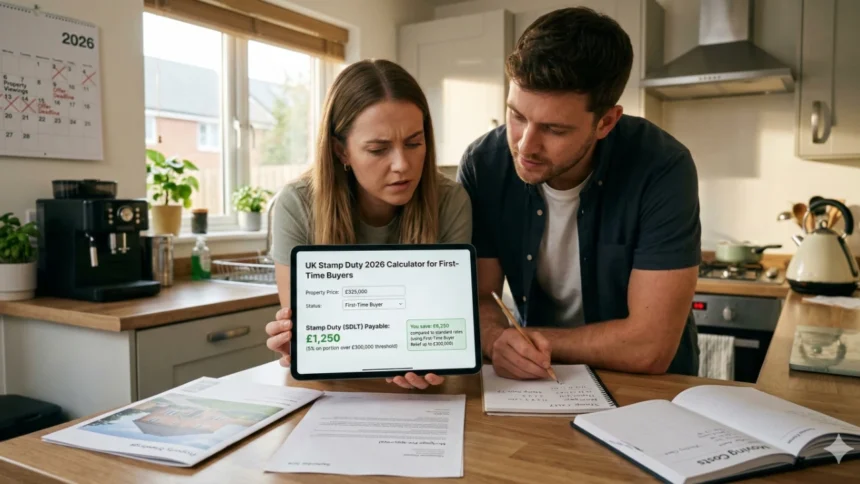
Stepping onto the property ladder is one of the most significant financial milestones in a person’s life. However, for those buying their first home in 2026, the financial landscape has shifted dramatically. The temporary Stamp Duty Land Tax (SDLT) cuts that buoyed the market in recent years officially came to an end on April 1, 2025. Today, in 2026, we are operating under the reverted, much stricter tax regulations.
As a certified UK property tax expert and mortgage advisor, I cannot overstate how critical it is to understand these changes. The threshold at which you begin paying stamp duty has plummeted, and the rules governing First-Time Buyer Relief are rigid. If you are calculating your deposit, assessing your mortgage affordability, or just beginning your property search, mastering the new £300,000 nil-rate band is the most important part of your financial planning.
In this comprehensive guide, we will break down the exact mechanics of the 2026 SDLT rules, navigate the dangerous “cliff edges” of property pricing, and provide you with the financial clarity needed to secure your dream home without unexpected tax bills.
How to Use the 2026 SDLT Calculator
Navigating property taxes manually can be fraught with errors, which is why utilizing an accurate, real-time tool is essential. The calculator above is programmed with the exact HMRC tax bands active for 2026. Here is a step-by-step guide to using it effectively to forecast your upfront purchasing costs:
- Enter the Property Purchase Price: Input the exact agreed (or anticipated) purchase price of the home. Do not include fixtures, fittings, or estate agent fees in this figure—SDLT is strictly calculated on the chargeable consideration of the property itself.
- Select Your Buyer Status: This is the most critical toggle. You must select “First-Time Buyer” to apply the 2026 relief rates. Be warned: if you are buying with a partner who has previously owned a home, you cannot select this option.
- Confirm Your Region: SDLT applies to properties in England and Northern Ireland. (Note: If you are purchasing in Scotland, you will pay the Land and Buildings Transaction Tax (LBTT), and in Wales, the Land Transaction Tax (LTT), which have entirely different tier systems).
- Calculate: The tool will output your exact tax liability, breaking down the calculation tier by tier so you can see exactly where your money is going.
The 2026 First-Time Buyer Stamp Duty Rules Explained
Let us look closely at the legislation that governs your purchase this year. The temporary relief that allowed first-time buyers to purchase homes up to £425,000 tax-free is gone. The April 2025 reversion is now firmly the law for 2026.
Here are the critical figures you need to memorize:
- The Nil-Rate Band: The 0% threshold for first-time buyers is now exactly £300,000. If your property costs this amount or less, you will pay absolutely zero stamp duty.
- The 5% Relief Tier: If your property costs between £300,001 and £500,000, you will pay 0% on the first £300,000, and a flat 5% tax on the portion that falls within this higher bracket.
- The Maximum Relief Limit: The maximum property value eligible for any first-time buyer relief is £500,000 (down from the previous £625,000 limit).
To understand how this progressive, slice-based tax system works, let’s look at two practical, mathematical examples.
More Read

Example 1: Purchasing Below the Threshold
Scenario: You have an offer accepted on a two-bedroom terraced house in Manchester for £295,000.
- The Calculation: Because the total purchase price falls underneath the £300,000 nil-rate band, the calculation is incredibly simple.
- The Result: You pay £0 in SDLT. Every penny of your savings can go directly toward your mortgage deposit, conveyancing fees, and moving costs.
Example 2: Purchasing Within the 5% Tier
Scenario: You are purchasing a flat in Outer London for £450,000.
- The Calculation: The tax is applied in “slices” (similar to income tax).
- Slice 1: £0 to £300,000 = 0% tax (£0)
- Slice 2: £300,001 to £450,000. This leaves £150,000 resting in the taxable 5% tier.
- 5% of £150,000 = £7,500.
- The Result: Your total SDLT liability is £7,500.
Your conveyancing solicitor will require this £7,500 to be transferred to them before the date of completion, alongside your deposit funds.
Standard Rates vs. First-Time Buyer Rates (Comparison)
If you do not qualify as a first-time buyer, or if you exceed the price limits for the relief, you are thrust into the standard residential SDLT rates. For 2026, the standard bands are highly punitive for lower-value transactions compared to the relief bands.
The standard SDLT rates for 2026 are:
- 0% up to £125,000
- 2% on the portion from £125,001 to £250,000
- 5% on the portion from £250,001 to £925,000
- 10% on the portion from £925,001 to £1.5 million
- 12% on anything above £1.5 million
Below is a clear comparative breakdown to illustrate the financial advantage of retaining your first-time buyer status.
| Property Value Portion | 2026 First-Time Buyer Rate | 2026 Standard Buyer Rate |
| Up to £125,000 | 0% | 0% |
| £125,001 to £250,000 | 0% | 2% |
| £250,001 to £300,000 | 0% | 5% |
| £300,001 to £500,000 | 5% | 5% |
| £500,001 to £925,000 | Relief Lost (See below) | 5% |
| £925,001 to £1.5m | Relief Lost | 10% |
| Over £1.5m | Relief Lost | 12% |
The £500,000 Cliff Edge: Losing Your First-Time Buyer Relief
One of the most dangerous traps in the 2026 UK property market is what tax professionals refer to as the “£500,000 Cliff Edge.”
If a first-time buyer purchases a property for £500,001 or more, they instantly and irreversibly lose all first-time buyer relief. You do not just pay a higher rate on the amount over £500,000; the HMRC retroactively applies the Standard SDLT Rates to the entire purchase from £0 upward.
The Cliff Edge Calculation Breakdown
Let us imagine you are looking at a property priced at £500,000, but a bidding war pushes your final accepted offer to £510,000.
If the relief still applied, you might assume you would just pay 5% on the amount between £300k and £510k. This is false. Because you crossed the £500,000 threshold, your first-time buyer status is legally nullified for tax purposes. You must now calculate your tax using standard bands:
- £0 to £125,000: 0% = £0
- £125,001 to £250,000: 2% = £2,500
- £250,001 to £510,000: 5% on this £260,000 portion = £13,000
- Total 2026 SDLT Bill: £15,500
If you had purchased the home for exactly £500,000, your tax bill under first-time buyer relief would have been just £10,000 (5% of the £200,000 above the £300k nil-rate band).
By offering just £10,000 more to secure the house, your tax bill skyrocketed by £5,500. This is why strict discipline regarding maximum bidding limits is vital. Conveyancers see buyers financially derailed by this cliff edge every week. If you are shopping in the high £400,000s, you must have a hard boundary at £500,000.
Who Actually Qualifies as a First-Time Buyer?
The term “first-time buyer” sounds self-explanatory, but HMRC’s legal definition is incredibly rigid. To claim the 2026 First-Time Buyer Relief, you must meet the following criteria:
- Global Property Ownership: You must never have owned a freehold or leasehold residential property anywhere in the world. If you owned a tiny apartment in Spain a decade ago, you are not a first-time buyer in the UK.
- Inheritance: If you inherited a property—even if you subsequently sold it without ever living in it—you are legally deemed to have owned a property. You are disqualified from the relief.
- Joint Purchases: If you are buying a home with a partner, spouse, or friend, both of you must be legitimate first-time buyers to claim the relief. If one of you previously owned a home, the entire transaction is subject to the Standard SDLT Rates.
- Beneficial Interest: If your parents bought a house but put it in your name, or you were named on the trust deeds of a residential property, you will likely be disqualified.
What about commercial property? There is a slight caveat here. If you have previously owned purely commercial property (like a shop or a farm with no residential dwelling attached), you may still qualify as a first-time residential buyer. However, your conveyancing solicitor must verify the exact classification of your previous assets.
Strategic Financial Planning: Can You Add Stamp Duty to Your Mortgage?
A common question among cash-strapped buyers is whether they can simply roll the SDLT bill into their mortgage loan, rather than paying it upfront in cash.
Technically, yes, you can borrow more from your lender to cover the cost of stamp duty, but as a mortgage advisor, I strongly caution against this unless absolutely necessary. Here is why:
1. The Loan-to-Value (LTV) Impact
Mortgage interest rates are heavily dictated by your Loan-to-Value ratio (the percentage of the property price you are borrowing compared to your cash deposit). The best interest rates are unlocked at lower LTVs (e.g., 60%, 75%, 80%).
If you have a 10% deposit (£45,000) on a £450,000 house, your LTV is 90%. If you need to borrow an extra £7,500 to pay the stamp duty, your total loan increases to £412,500. This pushes your LTV to almost 92%. Many lenders have strict cut-offs at 90% LTV for first-time buyers, meaning adding the tax to the loan could cause your mortgage application to be rejected entirely, or force you onto a much higher interest rate bracket.
2. Paying Interest on a Tax
If you roll £7,500 of stamp duty into a 25-year mortgage at an interest rate of 5%, you will end up paying thousands of pounds in interest over the life of the loan purely on that tax bill. You are essentially financing a government tax over two and a half decades.
3. Lender Restrictions
Some lenders strictly prohibit you from borrowing to fund stamp duty and legal fees, requiring proof of funds (bank statements) showing that you have the liquid cash available to clear these costs prior to the exchange of contracts.
The Expert Advice: Always aim to pay your SDLT, legal fees, and surveyor costs out of your own liquid savings. Keep these funds entirely separate from your mortgage deposit.
Comprehensive 2026 UK Stamp Duty FAQ
To ensure you have total clarity on the 2026 rules, here are detailed answers to the most common, complex questions first-time buyers ask.
When exactly is the stamp duty bill due to HMRC?
Legally, your Stamp Duty Land Tax return must be filed, and the tax paid, within 14 days of the “effective date of the transaction” (which is almost always the date of completion, when you get the keys). However, in reality, your conveyancing solicitor will demand that you transfer the SDLT funds to their client account before the completion date. They will then pay HMRC on your behalf on the day of completion to ensure no deadlines are missed and no penalties are incurred.
Do I pay stamp duty on a shared ownership property?
Yes, but the rules are highly complex. As a first-time buyer purchasing a shared ownership property in 2026, you generally have two choices:
Pay in stages: You pay SDLT only on the share of the property you are purchasing today. If your share is below the £300,000 threshold, you pay zero. If you “staircase” (buy more shares) later, you may have to pay SDLT then.
Make a Full Market Value Election: You choose to pay SDLT upfront based on the total market value of the property, not just your share. By doing this, you can utilize your £300,000 first-time buyer nil-rate band, and you will never have to pay SDLT again on that property, even if you buy the remaining shares later. Your solicitor will run the calculations to see which option saves you the most money.Do I pay SDLT on fixtures and fittings?
No. Stamp duty is only payable on the land and the buildings attached to it. “Chattels” (moveable items like free-standing wardrobes, carpets, curtains, and white goods) are not subject to SDLT. If you agree to buy the seller’s furniture for £5,000, you can subtract that £5,000 from the total purchase price before calculating your stamp duty. Warning: HMRC monitors this closely. You cannot falsely inflate the price of the carpets to £20,000 just to drop the property price below the £300,000 nil-rate threshold. It must be a fair and realistic valuation, or it will be flagged as tax fraud.
What if I buy a property with a “Granny Annexe”?
Properties with a self-contained annexe sometimes qualify for “Multiple Dwellings Relief” (MDR). However, the UK government abolished MDR for transactions completing on or after June 1, 2024. Therefore, in 2026, you cannot claim MDR. You will simply pay the standard first-time buyer rates on the total combined purchase price of the main house and the annexe, provided the total price is under £500,000.
I am buying a house in the UK, but I am not a UK resident. Are the rules different?
Yes, significantly different. If you are a non-UK resident (meaning you have been in the UK for fewer than 183 days in the 12 months before the purchase), you must pay a 2% Non-Resident Surcharge on top of the standard or first-time buyer SDLT rates. This applies even if you are a British citizen living abroad.
Can I claim the first-time buyer relief on a Buy-to-Let property?
No. To qualify for First-Time Buyer Relief, you must explicitly state that the property is going to be your primary residence. You must intend to live in it. If you are buying your very first property but plan to immediately rent it out to tenants, you must pay the Standard SDLT Rates. Furthermore, if you are buying it through a limited company, you will also be subject to the 3% additional dwelling surcharge.
Your Next Steps Toward Homeownership
Understanding the 2026 drop from the £425,000 threshold to the strict £300,000 limit is a harsh reality for many first-time buyers, but proper preparation makes it entirely manageable. By utilizing our calculator, rigorously adhering to your budget to avoid the £500,000 cliff edge, and keeping your tax funds separate from your mortgage deposit, you can ensure a smooth, stress-free conveyancing process.