


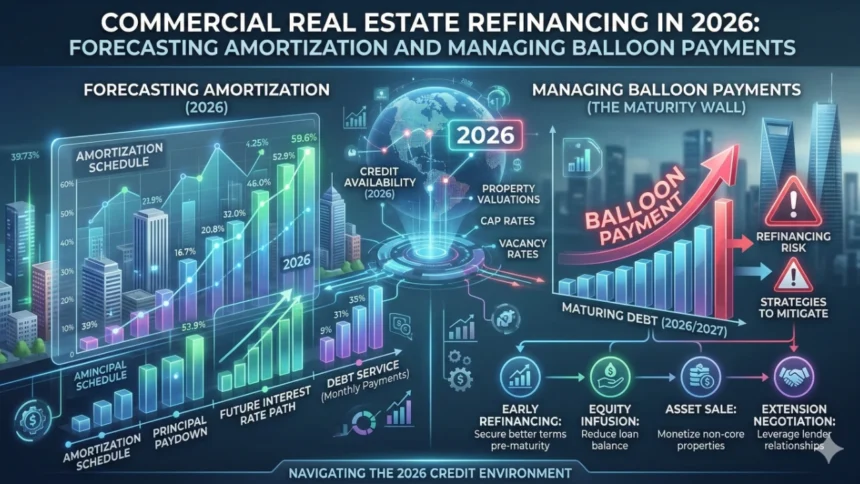
As we progress through the complexities of the 2026 commercial real estate (CRE) landscape, institutional investors, asset managers, and property developers face a defining moment in capital markets. The highly anticipated “maturity wall”—which saw trillions in legacy debt mature under extreme macroeconomic pressure over the past three years—has fundamentally reshaped underwriting standards. However, the narrative has shifted. Today, mastering your amortization schedules, understanding precise structural loan mechanics, and navigating the newly stabilized debt markets are the true keys to preserving equity and maximizing portfolio yield.
Entering 2026, the market has finally digested the aggressive rate-hiking cycles of previous years. Crucially, 2026 property-value resets have helped unlock previously frozen liquidity in the market. By establishing a new baseline for commercial valuations—particularly in the multifamily and retail sectors—these resets have allowed both traditional bank lenders and alternative private debt funds to return to the table with confidence.
For sponsors, this means refinancing is no longer purely a defensive maneuver; it is a strategic opportunity to restructure capital stacks. Navigating this environment requires an elite understanding of how Debt Service Coverage Ratios (DSCR), amortization schedules, and principal paydowns interact with current yield curves.
This comprehensive guide serves as the authoritative framework for commercial mortgage refinancing in 2026, designed to equip you with the mathematical and strategic insights required to underwrite your next exit or refinancing event.
How to Use the 2026 Commercial Mortgage Amortization Calculator
To accurately forecast your capital requirements and prepare for underwriting, our proprietary calculator allows you to model complex commercial debt structures. Understanding your exact principal reduction and future balloon payment is non-negotiable when approaching institutional lenders or private credit funds.
Here is how to structure your inputs for the most accurate projection:
- Principal Amount: The total quantum of the commercial mortgage loan you are seeking to refinance or originate.
- Interest Rate: The annual percentage rate. As of Q1 2026, recent fixed-rate commercial mortgage pools are seeing weighted average interest rates around 6.3%.
- Amortization Period: The theoretical timeline over which the loan would be fully paid off (typically 20, 25, or 30 years). The 25-year amortization is highly standard for stabilized assets in the current cycle.
- Term Length: The actual life of the loan before the remaining balance is due. In 2026, the 5-year (60-month) original loan term has cemented itself as the industry standard for commercial refinancing, balancing lender risk with borrower flexibility.
The Disconnect: Term Length vs. Amortization Period
One of the most defining characteristics of commercial real estate finance—and a frequent stumbling block for transitioning residential investors—is the deliberate structural disconnect between a loan’s amortization period and its term length.
Why the Bifurcation Exists
In a traditional residential mortgage, the term and amortization are identical (e.g., a 30-year fixed loan fully pays off in 30 years). In commercial finance, a loan may be amortized over 25 years to calculate the monthly debt service, but the term may strictly be capped at 5 years.
This creates a scenario where the sponsor makes payments as if they have 25 years to pay down the debt, but at month 60, the entirety of the unamortized principal becomes due immediately. This lump sum is the balloon payment.
More Read

The Strategic Benefit to the Lender
Lenders limit commercial terms to 5 or 10 years to aggressively mitigate interest rate risk and duration risk. Commercial assets are subject to market cycles, tenant lease expirations, and macro-economic shifts. By forcing a maturity event in 60 months, the lender ensures they are not locked into a sub-optimal yield if the market fundamentally changes, and it forces the sponsor to prove the asset’s viability through a refinance or sale.
The Strategic Benefit to the Sponsor
For the sponsor, extending the amortization period to 25 or 30 years artificially suppresses the monthly annual debt service. This dramatically boosts the property’s Net Operating Income (NOI) retention, improves cash flow, and inflates cash-on-cash returns. A 5-year fully amortizing loan would require astronomical monthly payments, crushing the property’s DSCR and rendering the investment unviable.
Calculating the Balloon Payment: A 2026 Mathematical Walkthrough
To thrive in the 2026 lending environment, sponsors must be able to mathematically forecast their balloon payments. Let us break down a real-world underwriting scenario utilizing the 2026 industry standards.
The Scenario:
- Loan Principal (P): $5,000,000
- Interest Rate (r): 6.3% (Weighted average for 2026 fixed pools)
- Amortization Period (n): 25 Years (300 months)
- Term Length (p): 5 Years (60 months)
Step 1: Calculate the Monthly Payment (PMT)
First, we calculate the monthly debt service using the standard amortization formula. The interest rate must be converted to a monthly rate, and the amortization period to months.
Monthly Rate $r = \frac{0.063}{12} = 0.00525$
Total Amortization Months $n = 300$
$$PMT = \frac{P \times r}{1 – (1 + r)^{-n}}$$
$$PMT = \frac{5,000,000 \times 0.00525}{1 – (1 + 0.00525)^{-300}}$$
$$PMT \approx \$33,151.10$$
The sponsor will pay $33,151.10 every month.
Step 2: Calculate the Balloon Payment (Remaining Principal)
At the end of the 5-year (60-month) term, the sponsor must pay off the remaining balance. We calculate the present value of the remaining 240 payments (300 months – 60 months).
Remaining Months $(n – p) = 240$
$$B = PMT \times \frac{1 – (1 + r)^{-(n – p)}}{r}$$
$$B = 33,151.10 \times \frac{1 – (1 + 0.00525)^{-240}}{0.00525}$$
$$B \approx \$4,517,275.61$$
The Analysis
Despite making $1,989,066 in total payments over 5 years ($33,151.10 × 60), the sponsor has only paid down $482,724.39 in principal. A massive $4,517,275.61 balloon payment is due at month 60. This heavy interest front-loading is exactly why sponsors must relentlessly forecast their exit caps and refinancing capabilities well before the maturity date.
Capitalizing on Tightening Spreads in 2026
The commercial debt markets have shifted dramatically since the volatility of the mid-2020s. Entering 2026, commercial mortgage loan spreads have tightened by roughly 183 basis points.
What This Means for Sponsors
Credit spreads represent the premium a lender charges above the risk-free rate (typically the SOFR curve or Treasury yields) to compensate for default risk. A tightening of 183 basis points (1.83%) signals a massive influx of liquidity and renewed institutional confidence in commercial real estate as an asset class.
This tightening is actively prompting sponsors to pursue early refinancings. Even factoring in standard prepayment penalties, the basis point reduction on a new 5-year term often results in millions of dollars in net interest savings and dramatically enhanced free cash flow over the hold period.
The Rise of Alternative Private Debt
While traditional CMBS (Commercial Mortgage-Backed Securities) and regional banks are active, private credit and debt funds are currently dominating the refinancing landscape. These alternative lenders are leveraging the 2026 property-value resets to safely deploy capital. Because valuations have stabilized at new, realistic baselines, debt funds are willing to offer highly competitive pricing, non-recourse structures, and flexible covenants to win premium assets away from legacy banks.
Underwriting Realities: DSCR and LTV in 2026
Lender underwriting in 2026 is uncompromisingly disciplined. While spreads have tightened, risk managers are laser-focused on operational fundamentals. Reliance on aggressive cap rate compression for exit strategies is dead; today, it is entirely about cash flow and debt yield.
Net Operating Income (NOI) and DSCR Requirements
Lenders require absolute certainty that the property’s trailing 12-month (T12) NOI can effortlessly cover the new, newly amortized debt service.
The Debt Service Coverage Ratio (DSCR) is the critical metric.
In 2026, institutional lenders typically demand a DSCR of at least 1.20x to 1.25x for stabilized assets (multifamily, industrial).
Example:
If your new annual debt service is $400,000, your property must generate an underwritten NOI of at least $500,000 (a 1.25x DSCR). If your NOI is only $450,000, the lender will restrict your loan proceeds, meaning they will lower the maximum loan amount until the $450,000 NOI satisfies the 1.25x ratio against the new debt service.
Loan-to-Value (LTV) Constraints
LTV is a secondary constraint but remains vital. It calculates the loan amount as a percentage of the property’s newly appraised value. Following the 2026 property-value resets, lenders are strictly capping leverage.
| Asset Class | Standard 2026 LTV Limit | Standard 2026 DSCR Requirement |
| Multifamily (Class A/B) | 65% – 70% | 1.20x – 1.25x |
| Industrial / Logistics | 60% – 65% | 1.25x – 1.30x |
| Retail (Grocery-Anchored) | 55% – 60% | 1.30x – 1.35x |
| Office (Class B/C) | 45% – 50% | 1.40x+ (Highly scrutinized) |
If a property suffered a valuation decline during the reset, a 65% LTV on the new value may not be enough to pay off the old balloon payment. This introduces the concept of a capital shortfall.
Strategies for a Shortfall: Navigating Valuation Gaps
What happens if the 2026 property valuation comes in lower than expected, and the maximum allowable loan proceeds cannot cover your maturity balloon? Sponsors must utilize advanced capital stack engineering to bridge the gap and prevent foreclosure.
1. The Cash-In Refinancing
The most straightforward, albeit painful, solution is the “cash-in” refinance. The sponsor (or their Limited Partners) makes a capital call and injects fresh equity into the deal to pay down the principal balance until the loan reaches the lender’s LTV and DSCR requirements. While this dilutes the internal rate of return (IRR), it preserves the asset and prevents a total wipeout of legacy equity.
2. Mezzanine Debt
Mezzanine debt sits subordinate to the senior mortgage but senior to common equity. It is not secured by the real estate itself, but rather by a pledge of the sponsor’s equity interests in the borrowing entity. If the senior lender tops out at 60% LTV, a mezzanine lender might provide the capital to bridge you up to 75% or 80% LTV.
- The Catch: Mezzanine debt is expensive. In 2026, mezzanine rates often range from 10% to 14%, and it acts as a heavy drag on total cash flow.
3. Preferred Equity (“Pref”)
Preferred equity operates similarly to mezzanine debt but is legally an equity position rather than a loan. It provides rescue capital to bridge a refinancing gap and demands a fixed rate of return (often 11% to 15%) paid out before any common equity partners see a dollar. In tight liquidity environments, specialized “rescue capital” funds deploy billions in preferred equity to bail out fundamentally sound but over-leveraged properties.
Comprehensive FAQ: Voice Search & Deep-Dive Mechanics
To fully equip you for the 2026 CRE market, we address the most pressing, highly technical questions commercial borrowers are asking today.
What is the standard amortization period for a commercial mortgage?
For stabilized, institutional-grade properties, the standard amortization period is 25 years. Credit tenants or newly constructed core assets (like Class A multifamily) may occasionally secure 30-year amortizations, particularly through agency lenders like Fannie Mae or Freddie Mac. Conversely, highly transitional assets or older office products are often forced into 20-year amortizations, which dramatically increases the monthly debt service burden.
Can I negotiate my commercial balloon payment?
You cannot negotiate the mathematics of the balloon payment once the loan is finalized, but you can aggressively negotiate the parameters that dictate it during origination. By negotiating a longer amortization schedule (pushing 20 years to 25 years), or securing a lower fixed interest rate, the principal paydown velocity changes, thereby altering the final balloon size. Additionally, you can negotiate extension options (e.g., a “5+1+1” structure), allowing you to pay a fee to extend the balloon maturity date by 12 to 24 months if market conditions are unfavorable at month 60.
How do prepayment penalties impact early refinancing?
With spreads tightening in 2026, many sponsors want to refinance before their 5-year term is up. However, institutional loans rarely allow penalty-free prepayments. You will likely encounter two primary penalty structures:
Yield Maintenance: The lender requires you to pay a penalty equal to the present value of the interest they would have collected over the remainder of the term. The lender essentially calculates the difference between your loan rate and the current Treasury yield, ensuring they do not lose money by having their capital returned early.
Defeasance: This is not a true prepayment, but a substitution of collateral. The sponsor must purchase a portfolio of U.S. Treasury bonds that exactly match the cash flow of the remaining mortgage payments. The bonds are handed to the lender, the real estate is released as collateral, and the sponsor is free to refinance. This is legally and administratively complex, requiring specialized defeasance consultants.What is a “Step-Down” prepayment penalty?
Often found in alternative private credit or regional bank loans, a step-down structure is highly favorable for borrowers. It applies a declining percentage penalty based on the year of payoff. A standard “5-4-3-2-1” structure means if you refinance in Year 1, you pay a 5% penalty on the principal balance; Year 2 is 4%, down to 1% in Year 5. In the 2026 market, sponsors are actively negotiating step-downs to capitalize on tightening spreads without suffering the punitive costs of defeasance.
What is a Debt Yield, and why do 2026 lenders care about it more than LTV?
LTV relies on an appraiser’s subjective valuation of the property. Debt Yield, however, is an unmanipulable metric. It is calculated simply as:
NOI / Total Loan Amount.
If a property generates $1,000,000 in NOI and the loan is $10,000,000, the Debt Yield is 10%. Lenders in 2026 heavily favor Debt Yield (typically requiring 8.5% to 10%) because it tells them exactly what their cash-on-cash return would be if they had to foreclose on the property on day one, entirely ignoring the hypothetical “value” of the asset.Does a longer term length mean a higher interest rate?
Yes. Due to the shape of the standard yield curve and duration risk, locking capital away for 10 years exposes the lender to more macroeconomic uncertainty than locking it away for 5 years. Consequently, a 10-year commercial mortgage will inherently carry a higher interest rate than a 5-year commercial mortgage. Sponsors must run a cost-benefit analysis: does the security of avoiding a balloon payment for a decade outweigh the drag of higher annual debt service?
How have the 2026 property-value resets changed the underwriting process?
Between 2023 and 2025, a massive bid-ask spread existed between buyers and sellers, and appraisers struggled to find comparable sales (comps). Lenders were paralyzed, leading to the liquidity freeze. The 2026 property-value resets represent capitulation; values have officially bottomed out and stabilized. Underwriters now have reliable, hard data to model risk, allowing them to accurately stress-test DSCR and LTV. This newfound certainty is precisely what has tightened spreads and brought both debt funds and CMBS lenders back into aggressive origination mode.