


🔥 Key Takeaways
- Inheritance Tax is increasingly affecting middle-class families due to frozen thresholds.
- Fiscal drag causes more estates to exceed tax-free thresholds as asset values rise.
- The Nil-Rate Band and Residence Nil-Rate Band have been frozen since 2009, impacting estate planning.
- Proactive estate planning can prevent the sale of family homes to pay IHT bills.
- Utilizing both the NRB and RNRB can shelter up to £1 million from Inheritance Tax.
Estate planning is rarely a topic anyone looks forward to discussing. It requires us to confront our mortality and navigate a labyrinth of complex tax legislation. However, ignoring it is perhaps the costliest mistake you can make for your loved ones. As a UK Chartered Tax Adviser, I see first-hand the devastating emotional and financial toll that an unexpected Inheritance Tax (IHT) bill can take on grieving families.
For decades, Inheritance Tax was viewed strictly as a “tax on the super-rich.” This is no longer the reality. As we navigate the 2026 tax landscape, sweeping legislative changes, combined with a stealthy economic phenomenon known as “fiscal drag,” have pulled millions of ordinary homeowners, farmers, business owners, and middle-class families into the crosshairs of HM Revenue & Customs (HMRC).
This comprehensive guide is designed to arm you with the knowledge needed to protect your family’s wealth. We will explore exactly how the frozen allowances impact your estate, dissect the sweeping April 2026 changes to business and agricultural reliefs, examine the new residence-based tax system, and prepare you for the upcoming 2027 pension reforms.
Our goal is simple: to ensure your hard-earned wealth ends up in the hands of your beneficiaries, not the taxman.
The Silent Wealth Eroder: Understanding “Fiscal Drag”
To understand why Inheritance Tax is becoming a mainstream problem in 2026, we must first understand fiscal drag.
Fiscal drag occurs when inflation and asset appreciation (such as rising property values and stock market growth) increase your nominal wealth, but tax thresholds remain entirely static. Instead of officially raising the tax rate, the government simply freezes the threshold at which you start paying tax. As your assets grow in value, a larger proportion of your estate is “dragged” over the threshold and into the taxable bracket.
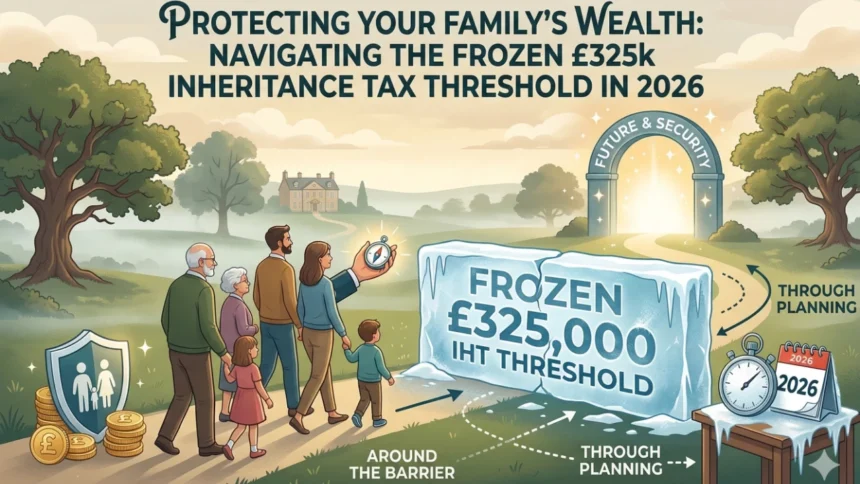
The Nil-Rate Band (NRB)—the amount you can pass on completely free of Inheritance Tax—has been firmly stuck at £325,000 since 2009. The Chancellor has confirmed that both the NRB and the Residence Nil-Rate Band (RNRB) of £175,000 will remain frozen until April 2030.
Consider the average property price in the South East of England or London. A modest family home purchased decades ago can now easily push an estate well over the frozen £325,000 threshold. Every pound above your available allowances is subject to a staggering 40% standard IHT rate. Without proactive structuring, your beneficiaries may be forced to sell the family home just to settle the HMRC bill.
How to Use the 2026 Interactive Inheritance Tax Calculator
To help you visualize your potential liability, we have provided an interactive calculator immediately below. Before diving into complex mitigation strategies, it is crucial to establish a baseline. Here is exactly how to input your data for an accurate 2026 assessment:
- Property Value: Enter the current market value of your primary residence and any secondary properties (buy-to-lets, holiday homes). Do not use the purchase price; use today’s estimated valuation.
- Savings & Investments: Include all cash savings, ISAs, stocks, and shares. (Note: Do not include your pension pot just yet, but keep the impending 2027 changes in mind, which we cover later in this guide).
- Business & Agricultural Assets: If you own a business or a farm, enter the value here. Pay close attention to our section on the April 2026 reforms to see how these will be taxed.
- Debts & Liabilities: Input any outstanding mortgages, personal loans, or expected funeral costs. These are deducted from your total estate value before tax is calculated.
- Marital Status: This is critical. Married couples and civil partners can share their allowances, effectively doubling their tax-free threshold.
- Direct Descendants: Check this box if you are leaving your main home to children, stepchildren, or grandchildren, which unlocks the £175,000 Residence Nil-Rate Band.
Once you have your estimated liability, the strategies outlined in the rest of this guide will help you legally and systematically dismantle it.
More Read

The Math of the Frozen Allowances: Maximizing Your Nil-Rate Bands
Navigating the frozen allowances requires absolute precision. The UK system offers two primary allowances, which, when used correctly by married couples, can shelter up to £1 million from the taxman. However, there are significant traps to avoid.
1. The Standard Nil-Rate Band (NRB)
Every individual is entitled to a standard NRB of £325,000. If your total estate (assets minus liabilities) is below this figure, no Inheritance Tax is due.
2. The Residence Nil-Rate Band (RNRB)
Introduced to help families pass on the family home, the RNRB provides an additional £175,000 allowance. To claim this, you must meet strict criteria:
- You must leave a qualifying residence (a home you have lived in) to direct descendants (children, grandchildren, stepchildren, adopted children, or foster children).
- Leaving the property to a sibling, nephew, or friend does not qualify for the RNRB.
Combining Allowances: The £1 Million Exemption
Transfers between spouses and civil partners are entirely exempt from Inheritance Tax, regardless of value. Furthermore, when the first spouse passes away, any unused proportion of their NRB and RNRB can be transferred to the surviving spouse.
- Surviving Spouse NRB: £325,000 (Own) + £325,000 (Inherited) = £650,000
- Surviving Spouse RNRB: £175,000 (Own) + £175,000 (Inherited) = £350,000
- Total Tax-Free Allowance: £1,000,000
The £2 Million Taper Trap
High-net-worth families must be acutely aware of the RNRB taper threshold. If your total net estate exceeds £2 million, the Residence Nil-Rate Band is gradually withdrawn.
For every £2 your estate exceeds the £2 million mark, you lose £1 of your RNRB.
| Estate Value | RNRB Available (Single) | RNRB Available (Couple) |
| Up to £2,000,000 | £175,000 | £350,000 |
| £2,100,000 | £125,000 | £300,000 |
| £2,350,000 | £0 | £175,000 |
| £2,700,000+ | £0 | £0 |
Strategic Insight: If you are hovering near the £2m mark, strategic lifetime gifting or implementing “deathbed planning” (such as giving away assets to charity or beneficiaries just before death) can bring the estate value back under £2m, thereby reclaiming the lost £350,000 RNRB for your family.
The April 2026 Shock: Sweeping Caps on Business and Agricultural Relief
For decades, families have relied on Agricultural Property Relief (APR) and Business Property Relief (BPR) to pass down working farms, family businesses, and AIM-listed shares entirely free of IHT. Until recently, eligible assets enjoyed 100% relief with no upper limit.
As of April 2026, this golden era of unlimited relief has abruptly ended. This represents one of the most seismic shifts in wealth preservation strategy in modern British history.
The New £1 Million Hard Cap
Under the new 2026 legislation, the 100% rate of relief for APR and BPR is strictly capped at a combined total of £1 million.
If your qualifying business and agricultural assets exceed £1 million in value, the excess will only receive 50% relief. Because the standard IHT rate is 40%, receiving 50% relief means these excess assets are now taxed at an effective rate of 20%.
Case Study: The Family Farm
Let’s look at the catastrophic impact of this change on a family farm valued at £4 million.
- Pre-2026 Rules: The entire £4 million farm passes down to the next generation tax-free (100% APR).
- Post-April 2026 Rules:
- First £1 million: 100% relief (£0 tax).
- Remaining £3 million: 50% relief.
- The £3 million is taxed at the effective 20% rate.
- New IHT Bill: £600,000.
A £600,000 sudden tax liability on an illiquid asset like a farm or a manufacturing business is often fatal. Families will be forced to sell land, liquidate business assets, or take on massive commercial loans simply to pay HMRC.
How to Restructure Before It’s Too Late
Business owners and farmers must act immediately. Mitigation strategies include:
- Spousal Transfers: The £1 million cap applies per person. By carefully transferring ownership shares between spouses, a married couple can effectively shield £2 million of business/agricultural assets at 100% relief.
- Accelerated Succession Planning: Consider passing shares or land to the next generation now as lifetime gifts (Potentially Exempt Transfers), hoping to survive the necessary 7 years (detailed later in this guide) to remove them from the estate entirely, bypassing the £1m APR/BPR cap.
- Corporate Restructuring: Reviewing shareholder agreements and utilizing specific trusts to lock in current valuations.
Expats and the Global Reach: The New Residence-Based Tax System
Another monumental change for 2026 is the complete abolition of the archaic “domicile” rule. Historically, your exposure to UK Inheritance Tax on your worldwide assets depended on your “domicile of origin” or “domicile of choice”—a highly subjective and often legally contested concept based on where you considered your permanent, long-term home to be.
Wealthy “non-doms” (non-domiciled UK residents) could live in the UK for years while keeping their offshore wealth shielded from the 40% IHT rate.
That system is gone. The UK has transitioned to an objective, residence-based system.
The “10-Out-Of-20 Years” Long-Term Resident Test
HMRC now operates a straightforward, mathematical test. You are considered in scope for UK Inheritance Tax on your global assets if you have been a UK resident for 10 out of the previous 20 tax years.
If you meet this threshold, it does not matter if you were born in Monaco, hold a US passport, or intend to retire in Dubai. Your entire worldwide estate—from a villa in Spain to a brokerage account in Singapore—is subject to the UK’s 40% tax rate.
The “Tail-End” Provision (The 10-Year Trap)
Perhaps more dangerously, escaping the UK tax net is no longer as simple as moving abroad in your later years. The new rules include a draconian “tail-end” provision.
If you have met the 10-out-of-20-year criteria and subsequently leave the UK, you remain liable for UK Inheritance Tax on your worldwide assets for a full 10 years after your departure.
Expats, returning UK citizens, and internationally mobile high-net-worth individuals must now engage in meticulous, cross-border estate planning. Utilizing offshore trusts prior to hitting the 10-year residency mark, or structuring investments via family investment companies, are now essential protective measures.
Strategic Gifting: Mastering the 7-Year Rule
One of the most powerful, yet most misunderstood, tools in your wealth preservation arsenal is giving your money away while you are still alive. However, HMRC does not simply let you empty your bank accounts on your deathbed to avoid tax.
Gifts are heavily regulated, and understanding the mechanics is vital.
Annual Exemptions and Allowances
You can make several types of gifts immediately without any IHT implications:
- The £3,000 Annual Exemption: You can give away up to £3,000 per tax year completely tax-free. If you didn’t use last year’s allowance, you can carry it forward for one year, allowing a married couple to gift up to £12,000 in a single year.
- Small Gifts: You can give up to £250 to as many individuals as you like per year (provided you haven’t used another allowance on the same person).
- Wedding Gifts: Parents can gift £5,000, grandparents £2,500, and anyone else £1,000 to a couple getting married.
- Gifts Out of Surplus Income: This is the most underutilized relief. You can make regular gifts of any size out of your after-tax income, provided the gifts do not impact your standard of living. This requires fastidious record-keeping but can funnel vast amounts of wealth out of your estate tax-free over a decade.
Potentially Exempt Transfers (PETs) and the 7-Year Rule
If you wish to give away larger assets—say, a £100,000 lump sum for a child’s house deposit, or a valuable piece of art—this is classed as a Potentially Exempt Transfer (PET).
The rule is simple in theory: If you survive for 7 clear years after making the gift, it falls completely outside of your estate for IHT purposes.
However, if you pass away within those 7 years, the gift is pulled back into your estate’s value.
Understanding Taper Relief
A common misconception is that taper relief reduces the value of the gift or the tax on your overall estate. It does not. Taper relief only reduces the tax payable on the gift itself (if the gift exceeded the £325,000 Nil-Rate Band).
If you die between 3 and 7 years after making a large PET, the tax rate on that specific gift tapers down:
| Years Survived After Gift | Tax Rate on the Gift (If above NRB) |
| Less than 3 years | 40% (No reduction) |
| 3 to 4 years | 32% |
| 4 to 5 years | 24% |
| 5 to 6 years | 16% |
| 6 to 7 years | 8% |
| 7 years or more | 0% (Fully exempt) |
Because gifts consume your Nil-Rate Band first chronologically, a large failed PET can wipe out your £325,000 allowance, leaving the rest of your estate fully exposed to the brutal 40% rate.
Red Alert: Pensions Entering the IHT Net in April 2027
For years, wealth managers and financial advisers have championed a specific strategy: spend your ISAs, savings, and property wealth in retirement, but leave your pension pot untouched.
Why? Because historically, defined contribution pension pots were held entirely outside of your estate for IHT purposes. You could pass a £1 million pension pot down to your children completely free of Inheritance Tax (though they might pay Income Tax on withdrawals if you died after age 75).
This major tax loophole is closing.
Starting in April 2027, unused pension funds and death benefits will be legally brought into the scope of Inheritance Tax. They will be added to the value of your estate and subject to the standard 40% rate if you are over your allowances.
The Double Taxation Threat
The 2027 legislation introduces a horrifying “double taxation” scenario for beneficiaries if you die after age 75.
- The pension pot will be taxed at 40% IHT.
- When the beneficiary withdraws the remaining funds, they will be taxed at their marginal Income Tax rate (up to 45%).
A £100,000 pension pot left to a higher-rate taxpayer could see £40,000 lost to IHT, and £24,000 of the remainder lost to Income Tax, leaving the beneficiary with just £36,000 of the original wealth.
What You Must Do In 2026
If you have heavily weighted your wealth into pensions to avoid IHT, you have a brief window in 2026 to course-correct:
- Reassess Drawdown Strategy: It may now be more tax-efficient to draw down larger sums from your pension now while you are alive, pay the income tax, and then strategically gift the capital via PETs to start the 7-year clock.
- Review Spousal Exemptions: Pensions left to a surviving spouse will still benefit from the spousal exemption, delaying the tax hit until the second death.
- Whole of Life Insurance: Consider drawing down pension income to fund the premiums on a ‘Whole of Life’ insurance policy, written in trust, designed specifically to pay the future IHT bill.
Protecting Liquid Assets: The Power of Life Insurance in Trust
While we focus heavily on property, businesses, and pensions, we must not forget cash flow. When an individual passes away, their assets are legally frozen until the executors obtain a Grant of Probate. This process can take 6 to 12 months.
However, HMRC requires the Inheritance Tax bill to be paid before they issue the Grant of Probate. This creates a vicious Catch-22: families cannot access the deceased’s bank accounts to pay the tax, but they cannot get probate to unlock the accounts until the tax is paid.
The solution is placing life insurance policies in trust.
When a life insurance policy is written in trust, it sits outside of your taxable estate. Upon death, the payout goes instantly and directly to the trustees (usually your family members), completely bypassing the lengthy probate process. This provides immediate, tax-free liquidity to settle the HMRC bill, saving your family from having to take out extortionate bridging loans. If you have life insurance, check with your provider immediately to ensure it is written in trust—it is a free, administrative step that saves immense hardship.
Comprehensive 2026 Inheritance Tax FAQs
To further clarify the intricacies of the modern tax landscape, here are answers to the most frequent, highly specific questions our advisory team receives from clients this year.
Do I pay inheritance tax on a property left to a sibling?
Yes, if your total estate exceeds the standard £325,000 Nil-Rate Band. Crucially, leaving your home to a sibling, niece, nephew, or friend means you u003cstrongu003ecannotu003c/strongu003e claim the additional £175,000 Residence Nil-Rate Band. The RNRB is strictly reserved for u0022direct descendantsu0022 (children, stepchildren, grandchildren).
Does the £175k residence band apply if I downsize or sell my home for care fees?
Yes, thanks to the u003cstrongu003edownsizing additionu003c/strongu003e. If you sold your primary residence after July 8, 2015, to downsize or move into residential care, you can still claim the RNRB. The rules are highly complex, requiring your executors to prove the value of the former home and ensure assets of an equivalent value are still left to direct descendants, but the relief is entirely secure if properly documented.
How is life insurance treated for IHT?
If your life insurance policy is written in trust, it is completely exempt from Inheritance Tax and pays out directly to your beneficiaries. If it is u003cemu003enotu003c/emu003e written in trust, the payout is added directly to the total value of your estate, artificially inflating your wealth and potentially pushing you into the 40% tax bracket. Always ensure policies are wrapped in a trust.
What happens if a PET is made, but the giver requires residential care a few years later?
If you make a massive financial gift (a PET) and subsequently run out of money to pay for your own care, local authorities can invoke the u003cstrongu003eDeprivation of Assetsu003c/strongu003e rules. They will argue you deliberately gave away wealth to rely on state-funded care. They can legally treat you as still owning that money for care fee assessments. Never gift money you may realistically need to sustain your own quality of life.
Are charitable donations exempt, and do they lower my overall tax rate?
Yes. Any amount left to a registered UK charity is 100% free of Inheritance Tax. Furthermore, if you leave at least u003cstrongu003e10% of your net estateu003c/strongu003e (the portion over your tax-free allowances) to charity, the IHT rate on the u003cemu003eremainderu003c/emu003e of your taxable estate is reduced from 40% to u003cstrongu003e36%u003c/strongu003e. This is a highly effective way to benefit a cause you care about while simultaneously softening the blow to your heirs.
Can I give my house to my children but continue living in it to avoid IHT?
No. This is known as a u003cstrongu003eGift with Reservation of Benefit (GROB)u003c/strongu003e. If you gift an asset but continue to enjoy a significant benefit from it (like living rent-free in a house you gave away), HMRC will treat the asset as if it never left your estate. It will still be subject to 40% IHT upon your death. To make it a valid gift, you must pay full, commercial market rent to your children to live there, and survive for 7 years.
How will the 2026 APR/BPR cap affect AIM-listed shares?
Historically, holding shares in qualifying Alternative Investment Market (AIM) companies for at least two years provided 100% Business Property Relief, making them a popular IHT mitigation tool. Under the April 2026 rules, these now fall under the £1 million cap combined with any other business/farm assets. Above £1 million, they will only receive 50% relief (taxed at 20%). Investors heavily weighted in AIM shares strictly for tax purposes must immediately review their portfolios with a wealth manager.
Take Control of Your Family’s Financial Future Today
The landscape of UK wealth preservation has fundamentally shifted. The frozen thresholds, the crushing April 2026 cap on business and agricultural reliefs, the rigorous new residence tests, and the looming 2027 inclusion of pensions mean that relying on outdated advice is no longer viable.
Inheritance Tax is largely a voluntary tax, paid predominantly by those who fail to plan in time. The strategies exist—from optimized gifting schedules to trust structures and corporate reconfigurations—but they require runway. The 7-year rule demands foresight, and the new legislative caps demand immediate structural adaptation.