


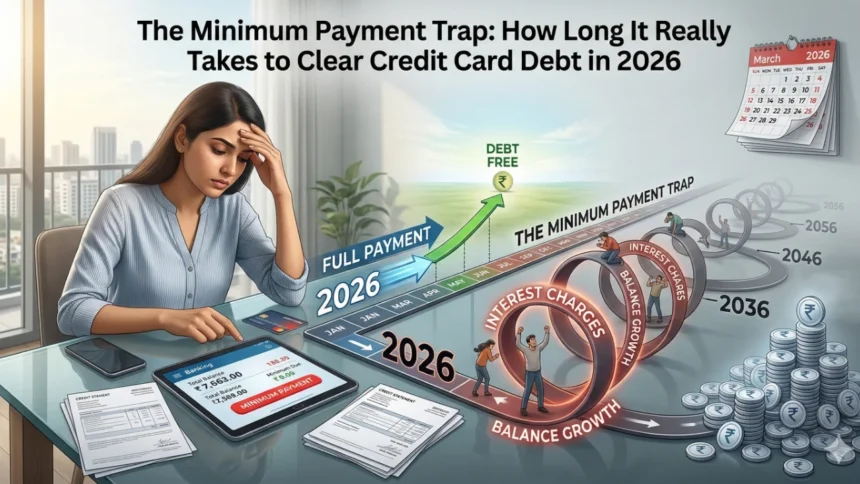
If you are looking at your credit card statement right now and feeling a sense of relief because the “Minimum Amount Due” is easily affordable, you are not alone. Millions of consumers experience this exact same psychological comfort every single month. It is a carefully engineered feature of the modern financial system. However, as a Certified Financial Planner (CFP) who specializes in consumer debt relief, I must be completely candid with you: that small number at the bottom of your statement is a mathematical trap designed to maximize bank profits at your direct expense.
Entering 2026, the global economic landscape has placed immense pressure on household budgets. In the United States alone, total consumer credit card debt has shattered previous records, hitting a staggering $1.28 trillion. Alongside these record balances, the cost of borrowing has skyrocketed. Average credit card interest rates currently hover securely between 19.4% and 22.30%, making the act of carrying a month-to-month balance more expensive than it has been in decades.
When you pay only the minimum, you are essentially treading water in a rapidly rising tide. Your payment is heavily consumed by high-interest charges, leaving your actual principal balance largely untouched. In this comprehensive guide, we are going to dissect the brutal mathematics behind minimum payments, explore how global regulators are stepping in to force transparency, and equip you with elite debt consolidation and payoff strategies to reclaim your financial freedom in 2026.
How to Use the 2026 Credit Card Payoff Calculator
To truly understand the gravity of your specific debt situation, you need personalized data. Before we dive into the deep mathematics of credit card debt, use the tool below to confront your numbers head-on.
A Step-by-Step Guide to Your Inputs
To get the most accurate projection of your debt timeline and potential interest costs, you will need to gather your most recent billing statements. Here is exactly how to use the calculator to model your financial future:
- Current Balance: Enter the total outstanding amount you owe on the card. Do not use your credit limit; use the exact balance listed as of today.
- Interest Rate (APR): Input your card’s Annual Percentage Rate. You can find this on the last page of your physical statement or under the “Account Details” section of your online banking portal. If you have different rates for purchases, balance transfers, and cash advances, use the rate that applies to the largest portion of your balance (usually the purchase APR).
- Expected Monthly Payment: This is where you can test different scenarios. Start by entering the Minimum Payment shown on your statement to see your baseline “worst-case scenario.” Then, increase this number by $50, $100, or $200 to see how drastically extra payments can reduce your timeline and save you money.
The Mathematics of the Minimum Payment
To understand why the minimum payment is so dangerous, we must pull back the curtain on how credit card issuers calculate it, and more importantly, how they calculate the interest that eats away at it.
How Your Minimum Payment is Calculated
Credit card issuers do not pick your minimum payment out of thin air. It is calculated using a specific formula outlined in your cardholder agreement. Generally, it is formulated in one of two ways:
- Percentage-Based: A flat percentage of your total balance, typically between 1% and 3%.
- Percentage Plus Interest and Fees: A smaller percentage of your balance (often 1%) plus all interest charges and late fees accrued during that specific billing cycle.
Most major banks use the second method. Because the payment includes the newly generated interest, it ensures that your balance technically decreases each month—but at an agonizingly slow pace. As your balance slightly decreases, your minimum payment also decreases the following month, stretching the repayment timeline out for years or even decades.
More Read

The Silent Killer: Daily Compounding Interest
The true devastating force behind credit card debt in a 2026 economy with 22.30% APRs is the mechanism of daily compounding interest. Your credit card company doesn’t just charge you interest once a month; they calculate it daily based on your Average Daily Principal Balance (ADPB).
For those mathematically inclined, the daily interest charge is calculated as follows:
$$I = ADPB \times \left(\frac{APR}{365}\right) \times \text{Days in billing cycle}$$
Because the interest is calculated daily and added to your balance, you are effectively paying interest on your interest. When you only send the minimum payment, up to 70% or 80% of that payment may go straight to the interest portion of the equation, leaving mere pennies to chip away at the actual debt ($ADPB$).
A Shocking 2026 Scenario: The $6,715 Balance
To fully grasp the financial devastation of minimum payments, let’s look at a highly realistic, statistically average scenario for a consumer in 2026.
Imagine you have accumulated an average credit card balance of $6,715. Your credit card issuer is charging you an APR of 22.30%. Your statement arrives, and it says your minimum payment is an easily manageable $150 a month.
If you decide to set up an auto-pay for exactly $150 and never put another charge on this card, here is the stark reality of your financial future:
- Time to Payoff: It will take you 99 billing cycles (over 8 years) to reach a zero balance.
- Total Interest Paid: You will pay an astonishing $8,054 in interest alone.
- Total Cost: That original $6,715 debt will ultimately cost you $14,769.
You read that correctly. By making only the minimum payment, you will pay more in interest than the items you originally purchased were even worth.
The Power of Increasing Your Payment
Let’s look at how mathematically sensitive credit card debt is to increased payments. The table below illustrates what happens when you decide to break the cycle and pay more than the minimum on that exact same $6,715 balance at 22.30% APR.
| Monthly Payment | Time to Payoff (Months) | Time to Payoff (Years) | Total Interest Paid | Interest Saved vs. Minimum |
| $150 (Minimum) | 99 months | 8.25 years | $8,054 | $0 |
| $200 | 52 months | 4.3 years | $3,516 | $4,538 |
| $300 | 30 months | 2.5 years | $1,965 | $6,089 |
| $500 | 16 months | 1.3 years | $1,059 | $6,995 |
Notice the exponential benefit: By just doubling your payment from $150 to $300, you don’t cut your payoff time in half; you cut it by nearly 70%, and you save over $6,000 in pure interest. This is the power of overcoming daily compounding interest.
Global Government Interventions: Protecting the Consumer
The predatory nature of compounding interest and minimum payment structures is not just a consumer grievance; it has become a matter of macroeconomic stability. Recognizing the severe financial harm caused by prolonged debt, international regulatory bodies have implemented aggressive interventions entering 2026.
The UK FCA Persistent Debt Rules
The United Kingdom’s Financial Conduct Authority (FCA) has been a global pioneer in identifying and regulating the minimum payment trap through its strict 36-month persistent debt rule.
The FCA defines a customer as being in “persistent debt” if, over a period of 18 months, they have paid more in interest, fees, and charges than they have paid toward the actual principal balance of their credit card.
The timeline of intervention works like this:
- Month 18: The credit card provider must explicitly contact the customer, warn them about the high costs of their repayment pattern, and prompt them to change their behavior.
- Month 27: If the pattern continues, a second, more forceful warning is issued.
- Month 36: The Legal Mandate. If the customer has still paid more in interest and fees than principal over a full 36-month period, the credit card provider is legally compelled to intervene. They must offer the customer a reasonable way to repay the remaining balance in a much faster timeframe (typically 3 to 4 years). If the customer cannot afford the accelerated payment plan, the provider must treat them as a customer in financial difficulty and offer forbearance options, which may include freezing interest rates or suspending fees.
India RBI Credit Card Rules 2025/2026
In a massive win for consumer protection, the Reserve Bank of India (RBI) implemented robust new credit card billing guidelines spanning 2025 and 2026. The RBI recognized that the “Minimum Amount Due” (MAD) was being fundamentally misunderstood by consumers as the “recommended” payment.
Under the latest RBI directives, credit card issuers operating in India must adhere to strict transparency mandates:
- Explicit Wealth Warnings: Billing statements must explicitly and prominently display warnings about the severe financial consequences of paying only the MAD. These warnings can no longer be buried in fine print; they must be clearly visible alongside the balance details.
- Time-to-Payoff Disclosures: Similar to frameworks in the U.S., Indian card issuers are now required to show customers exactly how many months or years it will take to clear their total outstanding balance if they continue paying only the Minimum Amount Due.
- Capitalization Limits: The RBI has tightened rules regarding the capitalization of unpaid charges. Issuers are strictly prohibited from charging interest on unpaid interest, late fees, or other charges, ensuring that compounding only applies to the principal purchase amounts.
These global shifts indicate a unified regulatory acknowledgment: the minimum payment is inherently dangerous to consumer wealth.
Breaking the Cycle: Debt Consolidation vs. Refinancing
If you are trapped in the cycle of 22%+ APRs, sheer willpower and small extra payments might not be enough. To truly escape, you need to alter the mathematical landscape of your debt. This is where strategic debt consolidation and refinancing come into play.
1. The 0% Introductory APR Balance Transfer Card
How it works: This strategy involves opening a new credit card that offers a 0% promotional interest rate on transferred balances for a set period (typically 12 to 21 months in the 2026 market). You move your high-interest debt from your current cards to this new card.
- The Benefit: 100% of your monthly payment goes directly toward your principal balance. There is no daily compounding interest fighting against you.
- The Catch: You will usually pay a balance transfer fee of 3% to 5% upfront. More importantly, if you do not pay off the entire balance before the 0% promotional period ends, the remaining debt will immediately become subject to a standard, high APR (often 20%+). Furthermore, you need a very good to excellent credit score to qualify for these premium cards.
2. Personal Debt Consolidation Loans
How it works: You take out a fixed-rate installment loan from a bank, credit union, or online lender and use those funds to pay off all your credit card balances immediately.
- The Benefit: You convert revolving, high-interest, compounding debt into a fixed monthly payment with a defined end date (e.g., a 3-year or 5-year term). In 2026, personal loan rates for borrowers with good credit typically range from 8% to 15%—significantly lower than the 22.30% credit card average.
- The Catch: You must have the discipline to not rack up new charges on your freshly zeroed-out credit cards. If you consolidate your debt but continue overspending, you will end up with a personal loan and new credit card debt, doubling your financial trouble.
3. Home Equity Products (HELOCs and Home Equity Loans)
How it works: Homeowners with substantial equity can borrow against the value of their property to pay off unsecured credit card debt.
- The Benefit: Because the loan is secured by real estate, interest rates are historically much lower than credit cards or even personal loans.
- The Catch: This is the highest-risk option. You are converting unsecured debt (credit cards) into secured debt (mortgage). If you default on a credit card, your credit score tanks. If you default on a Home Equity Line of Credit (HELOC), you could literally lose your house to foreclosure. As a CFP, I strongly advise using home equity for debt consolidation only as an absolute last resort, and only if the root cause of the overspending has been permanently corrected.
The Avalanche vs. Snowball Payoff Methods
If you cannot qualify for consolidation or prefer to tackle the debt where it currently sits, you need a structured payoff strategy. You should focus all your extra cash flow on one target card at a time while making exactly the minimum payments on the rest. There are two premier methods for doing this:
The Debt Avalanche (The Mathematical Champion)
The Debt Avalanche method is driven by pure, cold mathematics.
- List all your debts from the highest interest rate (APR) to the lowest interest rate.
- Make minimum payments on all cards.
- Pour every single extra dollar of your budget into the card with the highest APR.
- Once the highest APR card is paid off, roll that entire payment amount into the card with the next highest APR.
Why it works: By aggressively attacking the highest interest rate first, you minimize the amount of daily compounding interest the banks can charge you. The Avalanche method guarantees that you will pay the absolute least amount of money over the lifespan of your debt and finish debt-free faster than any other method.
The Debt Snowball (The Psychological Champion)
Popularized by behavioral economists and financial personalities, the Debt Snowball prioritizes human psychology over spreadsheet math.
- List all your debts from the smallest dollar balance to the largest dollar balance, completely ignoring the interest rates.
- Make minimum payments on all cards.
- Pour every extra dollar into the smallest balance.
- Once the smallest balance is cleared, roll that payment into the next smallest balance.
Why it works: Paying off debt is a grueling marathon. The Snowball method engineers quick, early “wins.” By rapidly clearing away small, annoying balances, you get a massive hit of dopamine and psychological momentum. This encouragement often keeps people motivated to stick to the plan over the long haul, whereas the Avalanche method can feel like a slow, unrewarding grind in the early months.
Comprehensive FAQ Section
To ensure you have a complete, 360-degree understanding of credit card minimum payments, I have compiled the most common questions clients ask me in my financial planning practice.
Does paying only the minimum hurt my credit score?
Paying the minimum does not directly cause negative marks on your credit report; in fact, it counts as an “on-time payment,” which is positive. However, paying only the minimum keeps your overall balance high. This negatively impacts your Credit Utilization Ratio (the amount of credit you are using compared to your total limits). If your utilization remains above 30%, it will significantly suppress your credit score, making it harder to qualify for mortgages, auto loans, or competitive consolidation rates.
Why did my minimum payment increase this month?
If you did not make new purchases, your minimum payment likely increased because your credit card has a variable interest rate that is tied to the Federal Reserve’s prime rate. If the central bank raises rates, your APR goes up, your interest charges increase, and therefore, your minimum payment formula yields a higher number. Alternatively, if you missed a payment, a costly “late fee” may have been added to your balance, spiking the minimum due.
Is it better to pay off a credit card in full or leave a small balance?
Always pay it in full if you can. There is a pervasive, completely false myth that leaving a small balance “shows activity” and boosts your credit score. This is financially disastrous advice. Leaving a balance means you forfeit your “grace period” and immediately begin accruing high-interest charges. You can build excellent credit by using the card for regular purchases and paying the statement balance down to exactly $0.00 every single month.
What actually happens if I pay less than the minimum amount due?
If you pay anything less than the exact minimum amount due, the credit card issuer will treat it as a missed or late payment. You will be hit with a late fee (often $30 to $40), and if the payment is more than 30 days past due, it will be reported to the credit bureaus, causing severe, long-lasting damage to your credit score.
Can I negotiate a lower interest rate with my credit card company?
Yes, absolutely. It is highly recommended that you call the retention department of your credit card issuer. If you have a history of on-time payments, you can simply ask, “Can you lower my APR?” Mentioning that you are considering transferring your balance to a competitor’s 0% card can sometimes incentivize them to drop your rate by a few percentage points to keep your business.
If I pay more than the minimum, how does the bank apply the extra money?
Thanks to the U.S. CARD Act of 2009, if you pay more than the minimum, the credit card company is legally required to apply the excess amount to the balance with the highest interest rate first. This protects you if you have different balances on the same card (e.g., a cash advance at 29% and regular purchases at 22%).
What should I do if I truly cannot afford the minimum payment anymore?
If you are facing true financial hardship (job loss, medical emergency) and cannot make the minimums, do not just ignore the bills. Contact your issuer immediately and ask for their “Hardship Program.” Most banks have internal programs that will temporarily lower your interest rate, waive fees, or reduce your minimum payment to keep the account out of default. If that fails, consult a non-profit Credit Counseling Agency to discuss a formal Debt Management Plan (DMP).
Your Financial Future is in Your Hands
The mathematics of 22.30% credit card debt in 2026 are unforgiving. The banking system has engineered the minimum payment to be a comfortable illusion, masking a reality where your hard-earned money is siphoned away through daily compounding interest.
However, you now have the knowledge to break the cycle. Whether you utilize a 0% balance transfer, a strategic personal loan, or the sheer mathematical force of the Debt Avalanche, every extra dollar you send to your issuer is a dollar invested directly back into your own financial freedom.