


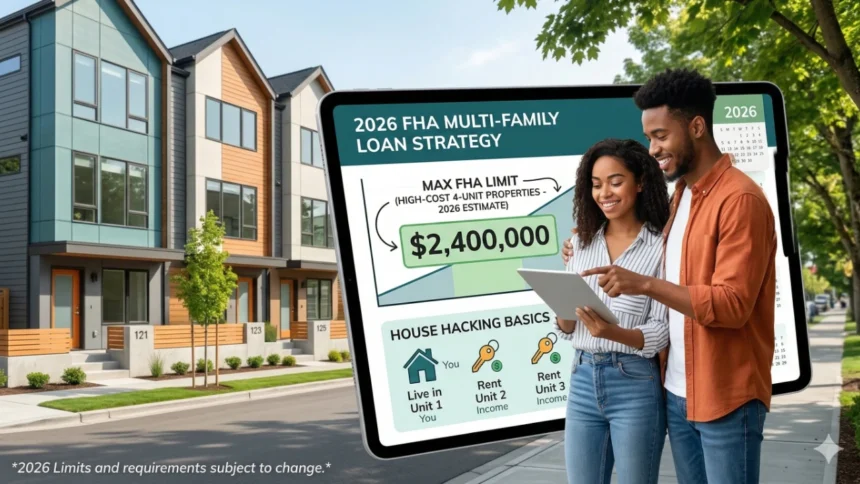
For ambitious real estate investors and savvy first-time homebuyers, the wealth-building landscape has a distinct, undeniable cheat code: house hacking a multi-family property using an FHA loan. By allowing you to purchase a 2-unit, 3-unit, or 4-unit property with a minimal down payment while living in one unit and renting out the others, the Federal Housing Administration (FHA) offers an unparalleled vehicle for forced savings, cash flow, and long-term equity accumulation.
As we navigate the 2026 real estate market, conventional loan requirements remain incredibly stringent for multi-family investments, typically demanding 15% to 25% down. In stark contrast, the 2026 FHA multi-family loan program permits down payments as low as 3.5%, even for highly lucrative fourplex properties. This means you can acquire up to $2.4 million in prime residential real estate with a fraction of the capital traditionally required by commercial or conventional investment avenues.
However, leveraging this government-backed program requires a deep, mathematically rigorous understanding of FHA underwriting guidelines. You are not just buying a home; you are acquiring a small business. From navigating the nuanced 2026 FHA loan limits to conquering the notoriously strict FHA Self-Sufficiency Test for 3- and 4-unit properties, passing the underwriting phase requires preparation and precision.
This comprehensive guide serves as your elite masterclass on the 2026 FHA multi-family requirements. We will dissect the exact loan limits, break down the strict income and credit rules, analyze the impact of mortgage insurance premiums (MIP), and show you precisely how to use projected rental income to exponentially increase your purchasing power.
How to Use the 2026 FHA Multi-Family Calculator
Before you begin analyzing properties on the MLS or negotiating off-market deals, you need a precise understanding of your financial leverage. The interactive calculator above is designed specifically for 2-to-4 unit FHA underwriting. It factors in the unique constraints of multi-family property acquisition, including vacancy factors and mortgage insurance.
To get the most accurate baseline for your prospective investment, input the following data points:
- Property Value (Purchase Price): Enter the total asking price or your target offer for the multi-family property.
- Down Payment Percentage: Input 3.5% if your FICO credit score is 580 or above. If your score falls between 500 and 579, you must input 10% to comply with FHA baseline requirements.
- Interest Rate: Enter the current market rate for government-backed FHA loans. Remember, multi-family FHA rates are typically very close to single-family FHA rates, which is a massive advantage over conventional investment loans that carry hefty interest rate premiums.
- Estimated Property Taxes & Insurance: Input the localized annual property tax rate and the estimated hazard insurance premium.
- Estimated Gross Rental Income: Enter the total projected monthly rent for all units combined—including the unit you plan to occupy, at its fair market value. This specific input is vital for the calculator to run the FHA Self-Sufficiency Test (required for 3- and 4-unit properties).
Once you plug in these metrics, the calculator will output your total estimated monthly PITI (Principal, Interest, Taxes, and Insurance), plus your monthly Mortgage Insurance Premium (MIP), and tell you whether the deal cash-flows or passes FHA underwriting.
Complete Breakdown of 2026 FHA Multi-Family Loan Limits
The FHA does not write blank checks. To ensure the program serves everyday homebuyers rather than institutional investors, the Department of Housing and Urban Development (HUD) establishes strict maximum loan limits. These limits are updated annually and are tied to the Federal Housing Finance Agency (FHFA) conforming loan limits.
For 2026, the FHA loan limits are categorized by the number of units and the cost of living in the specific county where the property is located.
- Low-Cost Floors: These are the standard maximum loan limits applied to most counties across the United States where median home prices are relatively low or average.
- High-Cost Ceilings: These elevated limits apply to expensive metropolitan statistical areas (MSAs) like Los Angeles, New York City, Honolulu, and Seattle, where housing costs vastly outpace the national average.
Here is the exact framework for the 2026 FHA Multi-Family Loan Limits:
| Property Type | 2026 Low-Cost Floor (Standard) | 2026 High-Cost Ceiling (Max) |
| 2-Unit (Duplex) | $693,050 | $1,599,375 |
| 3-Unit (Triplex) | $837,700 | $1,933,200 |
| 4-Unit (Fourplex) | $1,041,125 | $2,402,625 |
Investor Takeaway: If you are buying a fourplex in a high-cost coastal market in 2026, you can finance up to $2,402,625. With a 3.5% down payment ($87,052), you are controlling an ultra-premium multi-family asset that generates three separate streams of rental income to offset your living expenses. This is the definition of high-leverage wealth building.
More Read

Deep Dive: The FHA Self-Sufficiency Test (Crucial for 3-4 Units)
If you are buying a duplex (2 units), you can skip this section. However, if your goal is to maximize your doors by purchasing a triplex or fourplex, you are about to face the single biggest hurdle in FHA underwriting: The FHA Net Rental Income Self-Sufficiency Test.
HUD requires that 3- and 4-unit properties be financially viable enough to carry their own weight in a worst-case scenario. The rule mandates that 75% of the appraised gross rental income from all units (including the one you will live in) must be equal to or greater than the full monthly mortgage payment (PITI + MIP).
Why 75%? The FHA assumes a 25% “haircut” to account for standard real estate operational frictions: unit vacancies, maintenance, bad debt, and management fees.
The Self-Sufficiency Mathematical Formula
(Total Gross Appraised Monthly Rent × 0.75) ≥ Total Monthly PITI + MIP
Scenario Analysis: Failing vs. Passing the Test
Let’s look at a hypothetical 2026 purchase of a $1.2 Million Fourplex in a high-cost market to see how this rule makes or breaks a deal.
- Purchase Price: $1,200,000
- Down Payment (3.5%): $42,000
- Base Loan Amount: $1,158,000
- Plus 1.75% UFMIP: $20,265
- Total FHA Loan: $1,178,265
- Estimated Monthly PITI & MIP: ~$8,500/month (assuming a 6% rate, plus taxes/insurance)
To pass the FHA Self-Sufficiency Test, the rental math must work as follows:
- We take our PITI ($8,500) and divide it by 0.75 to find our absolute minimum gross rent.
- $8,500 ÷ 0.75 = $11,333 in required total monthly gross rent.
- Therefore, each of the 4 units must have a fair market rent of at least $2,833 per month.
Scenario A (The Deal Dies): The FHA appraiser determines that market rent for these units is only $2,200 per month. Total gross rent is $8,800. We apply the 75% rule ($8,800 × 0.75 = $6,600). Because $6,600 is less than the $8,500 mortgage payment, the property fails the test. The FHA will not approve this loan, regardless of how much outside income you make.
Scenario B (The Deal Funds): The FHA appraiser determines market rent is $3,000 per unit. Total gross rent is $12,000. We apply the 75% rule ($12,000 × 0.75 = $9,000). Because $9,000 is greater than the $8,500 mortgage payment, the property passes the Self-Sufficiency Test with flying colors.
Pro-Tip for 2026: In high-interest-rate environments, the PITI payment balloons, making the self-sufficiency test incredibly difficult to pass unless the property is heavily undervalued or rents in the area are astronomically high. If you fail the test, your only solutions are to buy down the interest rate (lowering PITI), put more money down (lowering the loan amount and PITI), or find a property with a better price-to-rent ratio.
Qualifying for a Multi-Family FHA Loan in 2026
FHA loans are government-insured, meaning the lender takes on far less risk. Because of this, the underwriting guidelines for borrowers are significantly more forgiving than conventional commercial guidelines. However, you must still prove you are a creditworthy borrower capable of managing an investment property.
1. The FICO Credit Score & Down Payment Matrix
The foundational requirement for an FHA loan dictates your minimum required down payment based on your credit health:
- 3.5% Down Payment: Requires a minimum FICO credit score of 580. This is the golden ticket for house hackers looking to preserve their liquid capital for future property renovations or emergency reserves.
- 10% Down Payment: Required if your FICO credit score falls between 500 and 579. While a 10% down payment requires more upfront cash, it is still drastically lower than the 20-25% required by conventional investment loans.
Note: While 580 is the FHA’s absolute minimum for the 3.5% tier, individual lenders may apply “overlays” (their own stricter internal rules) and require a 600 or 620 score. Shop around if a lender denies you based on a 580-600 score.
2. Debt-to-Income (DTI) Ratio Limits
Your Debt-to-Income (DTI) ratio is a comparison of your gross monthly income to your total monthly debt obligations (car loans, student loans, minimum credit card payments, and the projected mortgage).
- For optimal approval odds in 2026, your front-end DTI (housing payment only) should not exceed 31%, and your back-end DTI (all debts combined) should stay at or below 43%.
- In certain scenarios, if you have strong compensating factors (like excellent credit, massive cash reserves, or residual income), automated underwriting systems may approve DTIs up to 45% or even 50%, but aiming for a maximum of 43% ensures a smoother manual underwriting process if necessary.
3. The Owner-Occupancy Mandate (The “House Hack” Rule)
FHA loans are explicitly designed to promote homeownership, not to fund absentee landlords. Therefore, you must intend to occupy the property as your primary residence.
- You must move into one of the units within 60 days of closing.
- You must live in the unit as your primary residence for a minimum of one full year (12 months).
- After the 12-month period expires, you are legally free to move out, rent out your former unit, and keep the FHA loan in place as a fully cash-flowing investment property. You can even use a new primary residence loan (like a 5% down conventional loan) to buy your next property!
Using Projected Rental Income to Qualify
One of the most powerful, wealth-accelerating secrets of the 2026 FHA multi-family loan is how it handles your DTI ratio. If you are a single buyer making $75,000 a year, qualifying for a $1,000,000 fourplex mortgage on your salary alone is mathematically impossible. Your DTI would be astronomically high.
This is where FHA multi-family shines: Underwriters allow you to use the projected rental income from the other units to help you qualify for the loan.
When you place an offer on a 2-4 unit property, the FHA appraiser will fill out FHA Form 1025 (Small Residential Income Property Appraisal Report). This report includes a localized rent schedule, determining the exact fair market value of the vacant units.
The underwriter will take that gross projected rental income, apply the standard 75% rule (assuming a 25% vacancy/maintenance loss), and add that adjusted income to your personal W2 or 1099 income. Example of Income Stacking:
- Your personal monthly income: $6,000
- Gross rent from 3 other units in a fourplex: $4,500/month
- FHA adjusted rent (75%): $3,375/month
- Your new qualifying monthly income: $9,375
This mechanism drastically lowers your back-end DTI, allowing you to punch far above your weight class and secure assets that would typically require a massive dual-income household to qualify for.
The Cost of FHA Mortgage Insurance (MIP) on Multi-Family Homes
The tradeoff for putting down a microscopic 3.5% on a high-value real estate asset is that you must pay Mortgage Insurance Premiums (MIP). Because the FHA is insuring the lender against your potential default, you foot the bill for that insurance. For 2026, the FHA MIP structure consists of two distinct fees:
1. Upfront Mortgage Insurance Premium (UFMIP)
Every FHA loan requires a one-time Upfront MIP fee equal to 1.75% of the base loan amount.
- If your base loan is $1,000,000, the UFMIP is $17,500.
- The Good News: You do not have to pay this out of pocket at the closing table. The FHA allows you to roll this entire $17,500 directly into the total loan balance.
2. Annual Mortgage Insurance Premium (Annual MIP)
In addition to the upfront fee, you will pay an ongoing annual premium, which is divided by 12 and added to your monthly mortgage payment. In recent years, HUD reduced these premiums to improve affordability. For 2026, the rates depend on your loan amount, term, and Loan-to-Value (LTV) ratio.
- Base Loans (under $726,200) with 3.5% down: The annual MIP is typically 0.55%.
- Jumbo FHA Loans (over $726,200) with 3.5% down: Because multi-family limits often push past the standard single-family bounds in high-cost areas, higher loan balances carry higher risk. For loan amounts above $726,200 with minimum down payments, the annual MIP scales up to 0.75%.
The Cash Flow Impact: A 0.75% annual MIP on a $1,500,000 loan balance equals $11,250 a year, or an extra $937.50 added to your monthly payment. As an investor, you must factor this directly into your cash-on-cash return calculations. FHA MIP stays on the loan for the entire 30-year term if you put down less than 10%. The only way to remove it is to build enough equity (usually 20%) and refinance out of the FHA loan into a conventional multi-family mortgage.
Comprehensive FAQ Section
To ensure you are fully equipped to dominate the 2026 real estate market, here are the answers to the most common, high-intent questions aspiring multi-family investors ask:
Can I buy a 4-unit property with an FHA loan?
Yes. The FHA specifically allows the financing of 1-unit to 4-unit residential properties. A 4-unit property (fourplex) is the absolute maximum limit. Anything with 5 units or more is legally classified as commercial real estate and is strictly ineligible for FHA financing; it would require a commercial loan.
Does the FHA Self-Sufficiency Test apply to duplexes?
No. The notoriously strict FHA Self-Sufficiency Test (the rule stating that 75% of gross rents must cover the entire mortgage payment) strictly applies to 3-unit and 4-unit properties only. If you are buying a duplex, you do not have to worry about this specific mathematical hurdle, making duplexes a much easier entry point for first-time house hackers in expensive markets.
Can I use an FHA loan for an Airbnb or short-term rental multi-family?
No. FHA guidelines are exceptionally strict about the intended use of the property. The FHA does not allow the underwriting of properties that are explicitly designed or operated as transient housing, hotel/motels, or short-term rentals (like Airbnb or VRBO) where leases are less than 30 days. You must qualify using long-term residential lease projections, and the property must function as long-term housing.
What happens if the vacant units need massive repairs before I can rent them?
FHA has standard minimum property requirements (MPR) focused on safety, security, and soundness. The property must be in livable condition at closing. If the vacant units are heavily distressed (e.g., missing plumbing, severely damaged roofs, hazardous electrical), the standard FHA 203(b) loan will be denied. Instead, you would need to look into an FHA 203(k) Rehabilitation Loan, which allows you to finance both the purchase price and the cost of the multi-family renovations into a single loan.
Can I use rental income from the unit I plan to live in to qualify?
No. When calculating your qualifying income, the FHA will only allow you to use the projected (or current lease) income from the other units that you are strictly renting out to tenants. You cannot count “phantom rent” for the unit you will be occupying as your primary residence.
Are FHA loan limits per property or per borrower?
FHA loan limits apply strictly to the property, based on its county and the number of units. However, you as a borrower are generally restricted to having only one active FHA mortgage at a time. Exceptions exist (such as relocating for a job that is too far to commute from the original property, or an increase in family size that the current home cannot accommodate), but generally, you cannot stack multiple FHA multi-family loans simultaneously.
Do I need landlord experience to use projected rental income for FHA qualifying?
No! This is one of the greatest benefits of the FHA multi-family program for beginners. Unlike conventional investment loans that often require two years of documented landlord history on your tax returns, the FHA does not require prior property management experience to use the 75% projected rental income rule to help you qualify.
6.
7.
The 2026 FHA Multi-Family loan is arguably the single most powerful financial tool available to the middle class for generating generational wealth. By mastering the self-sufficiency rule, optimizing your credit score to secure the 3.5% down payment, and accurately forecasting your rental income, you can transform your housing expense into a cash-flowing asset portfolio.